
Gluttony
Aliases: Gluttony
- Type
- Grimoire (artifact)
- Set
- Seven Sins
- Sin
- Gluttony
- Diet
- Books and magical items
- Counterpart
- Pride (Superbia)
- Origin
- Age of Myths
Description
Gluttony is the central artifact of the story and the source of all of Theodore Miller's power. It is an ancient grimoire of the Seven Sins set, its roots reaching into an age long erased from the chronicles. Theodore finds it in the library of Bergen Academy as an unremarkable, worn book: the moment he touches it, a tongue bursts from his palm, seizes its prey, and draws it inside. This is how Gluttony feeds — it consumes magical items and, above all, books, and every meal benefits its owner. To the grimoire, books are food piled in heaps, and the reward is tied directly to what was eaten.
The mechanic is simple and merciless: a swallowed book lodges whole in Theodore's memory, and if it describes a spell he masters it at once. The talentless Theo, feeding the grimoire a 'Manual of Lightning Magic,' instantly gained the Lightning Strike that had failed him hundreds of times. The richer the fare, the greater the return: the original 'Ballistic Magic,' written by the war hero Alfred Bellontes, gave Theo not just the Magic Bullet but Synchronization itself — the chance to relive the author's experience and wisdom, grasping what scholars had failed to crack in thirty years. As seals are removed, the grimoire unlocks Memorization (spells in slots), Overwrite (merging with a devoured book's author), Appraisal (identifying items in advance), and an inventory — powers Theodore himself calls outright cheating.
The grimoire has a personality and a voice of its own — eerie and gurgling, speaking straight into its host's mind and audible to him alone. Gluttony is lazy, proud, mocking, sharp-tongued, and sleeps almost constantly, waking only to eat or advise; it scorns cheap fare, takes pride in worthy meals, and gladly trades barbs even with other grimoires. It is dangerous: if not fed, it begins to regard its host as food. Its power unlocks in stages — seals bind it, and they fall not at will (the grimoire cannot unseal itself) but as Theodore's deeds and strength grow, by the standards of the Seven Sins system.
As a being that witnessed the Age of Myths, Gluttony preserves the memory of ancient gods, dragons, and forgotten relics, and often becomes Theodore's sole source of knowledge on matters that defeat even the archmages of the present. Its direct opposite is Pride (Superbia), which eats living creatures and takes their finest qualities; their enmity is inevitable, for their very natures contradict each other. By the grimoire's account, the bodies of the Seven Sins lie outside this dimension, and the Gluttony of this world is but one of many scattered across the universe. In the finale Gluttony's greed prevails: its 'devour' power turns on its own contractor, and Theodore, to survive, breaks the contract — by literally shattering his own soul. The parting is bitter: the grimoire calls Theodore the most mysterious and the greatest of all the mages it ever contracted.
How It Works
The grimoire absorbs books and artifacts by extending a tongue from its owner's palm; what is swallowed vanishes utterly, leaving only knowledge in memory and a gain in magical power. A devoured book is memorized completely, and if it describes a spell, Theodore masters it at once. The rarer and more valuable the fare — especially an original in the author's own hand — the greater the return and the higher the chance to inherit the author's very experience through Synchronization.
Removing seals unlocks new functions: Memorization (storing spells in slots), Overwrite (merging with a devoured book's author), Appraisal (knowing in advance what a meal will yield), an inventory, and mental speech. Devouring dangerous items (such as the warlock Jerem's vessel) may destroy the owner's body unless a further seal is removed or his achievements are high enough. Its hunger must be sated regularly, or the grimoire turns on its host.
Nature & Personality
Gluttony is sentient and speaks in a gurgling, unnatural voice straight into Theodore's mind — audible to its owner alone. It is lazy, proud, mocking, and sleeps almost constantly. It scorns cheap food, takes pride in worthy meals, and gladly trades barbs even with other grimoires, especially Pride (Superbia), whose form it calls repulsive.
By nature it is not an autonomous, free-roaming grimoire (unlike Superbia and Invidia): without a contractor its capacity to act on its own is limited, and if the host flees without a fight the grimoire simply self-destructs. Over the story Gluttony turns from a threatening parasite into a loyal, if caustic, ally — yet its innate greed remains a delayed-action mine.
Seals, History & Finale
Seals bind the grimoire and fall as Theodore's deeds and strength grow: the 4th seal unlocks its autonomous function (which the system may temporarily forbid if the seal was removed by an 'unusual method'), and the 5th opens new powers and the right to learn secrets previously withheld. For the Seven Sins grimoires, removing seals is a 'return to the original state': at the 5th stage Superbia overcame an adult dragon, and at the 6th, by her measure, one could single-handedly kill an ancient dragon.
Gluttony is a product of the Age of Myths and preserves its knowledge, making it a priceless source on ancient gods, dragons, relics, and the Seven Sins themselves. In the finale the grimoire's greed prevails and its 'devour' power turns on Theodore. The contract binds them directly, and Theodore severs it the only way possible — by shattering his own soul, so that the connection point (his left hand) is restored and the grimoire does not at first realize the contract is already broken. The farewell is bitter: Gluttony names Theodore the greatest of its contractors.
Relationships
-
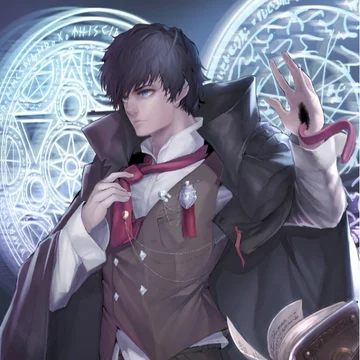 Theodore MillerContractor/Owner
The grimoire's owner and the only one who hears its voice; in the finale he breaks the contract by shattering his own soul.
- Seven SinsMember of the set
Gluttony is one of the seven demonic grimoires embodying the deadly sins.
- Age of MythsOrigin
The grimoire dates from the Age of Myths and preserves its knowledge.
- CircleRelated term
Lets Theodore climb the Circles despite his zero affinity.